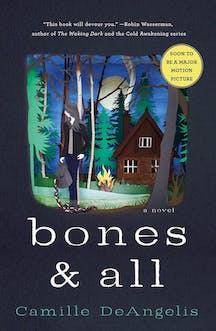
 Maren just turned sixteen when her mother suddenly abandons her. Scared and alone, she hitchhikes around the Midwest searching for a place to call home while hiding a deep, dark secret. When she meets Lee in a Walmart parking lot, she is instantly relieved, because it is clear that they are cut from the same bloody cloth. They begin watching out for each other and hiding their secret from the world while becoming closer and closer. But can they live off love alone? Especially when their hunger is insatiable? It’s hard to not be coy about this book, but if you are at all intrigued by what you’ve read so far, never fear: Maren’s secret is revealed on the first page (hint: they are NOT vampires). While there were just a few too many convenient coincidences in the plot, the romantic vibes ares strong (especially with that smoking Timothée Chalamet movie poster cover). This on-the-road love story felt like a mash-up of Let the Right One In and American Honey, and even though I am comparing it to films, was a book before it was this so dark and decadent-looking movie. I’ll leave it up to you which one you want to dish up first!
Category: Teen Tearjerkers
Stories that will make you sniff

Family of Liars by E. Lockhart
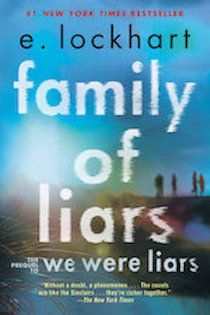
In 2014, this book by criminally awesome mastermind E. Lockhart came out and I was blown away and unable to reveal a single thing, because to say anything was to spoil everything. Now the prequel to this book has come out (or will come out May 2022) and I am AGAIN blown away and AGAIN, can say very little because this deliciously nasty little package is just one big SPOILER. What I can say is that if you loved Liars, you will love this. What I can say is that this prequel delves into the teenage pasts of Cady’s mom (Penny) and her two sisters (Carrie and Bess) and that this story is eldest sister Carrie’s. What I can say is that Sinclair family’s curse didn’t start with Cady and likely doesn’t end with her either. Here in Carrie’s story of where it all began to go so wrong there is love, madness, corruption, addiction, loyalty, fear and doubt. So much doubt. Carrie will tell you “On the outside, I am gray-eyed and butter blonde…I have the confident walk and good shoulders of an excellent softball player…I fix my sister’s problems. Those are the qualities anyone can see.”
“But my insides are made of seawater, warped wood and rusty nails.”
Now an adult, Carrie is tormented by what happened the summer she was seventeen, when she met a gorgeous, careless boy while still in mourning for the person she loved best. Her entire life has been colored by the secrets created and the betrayal committed that summer, secrets that can never be told and betrayals that can never be forgiven. Once you see the tragic connections that tie Cady and Carrie’s stories together, you can never unsee them. These are lies that bind.
Run, don’t walk to pre-order this monstrous gem that’s coming your way 5/3/22.
Instructions for Dancing by Nicola Yoon

High school senior Evie Thomas was a compulsive romance reader and true love aficionado–until her dad cheated on her mom and they got a divorce. Now Evie wishes “I could go back to being the girl who thought her parents, especially her dad, could do not wrong…I used to believe in happily-ever-afters because they had one.” Grieving the end of her parents’ marriage, Evie declares war on love, and decides once and for all to get rid of her beloved romance novel collection. But a funny thing happens when she drops off her books at the little free library near her L.A. neighborhood. Evie meets an odd old woman who insists she take a used book from the library called Instructions for Dancing. Then shortly after she returns home, she begins seeing visions of the end of strangers’ love affairs. All she has to do is catch a random couple kissing, and suddenly she sees their whole relationship unfold in her head until it ends–badly. Hoping to stop the visions, she decides to follow the book’s directions and take dance lessons from the studio listed in the back. And that is where she meets tall, dark and handsome X, who threatens to sweep her off her feet with his witty banter and dashing good looks. But Evie flatly refuses to fall for his many charms. Hasn’t she seen for herself that love never works out, even when it seems like a sure thing? They are signed up for a dance contest by their instructor, and suddenly Evie finds herself spending way too much time with X’s gorgeous self. She will not fall in love! She will not! But the universe and the little free library lady have something else in mind for Evie, and if she’s not careful, she’ll find her cynical heart cracked wide open. Queen of Swoon Nicola Yoon’s effervescent third novel about love, loss, friendship and family, will leave your toes tapping and your heart yearning. I sobbed like a baby when I turned the last page, and you will too when it comes to a library, bookseller or e-reader near you June 2021.
Dancing at the Pity Party by Tyler Feder


What do you do when you find out that your mom and best friend is dying of cancer? Weep with sadness? Rage at the unfairness of it all? Yes, and sometimes even write a stunningly good graphic memoir about it. Now ten years after Tyler Feder‘s mom died during her sophomore year of college, she has written a frank, poignant and even funny road map of how to navigate being in the “dead mom club.” Tyler’s mom Rhonda was awesome. She had a signature pixie hair cut, made amazing Halloween costumes and birthday decorations, and loved perfumed hand lotion and scary carnival rides. Feder’s choice to render her sad family history in a soft pastel pink palette helps soften the blow of seeing effervescent Rhonda lose her dark mop of hair and descend into sickness. With the benefit of healing time, Feder is even able to seed her story of grieving with gentle humor. There’s tips on “how to make a good cry a great cry,” “Dead Mom: The App,” and a “My mom died young reaction Bingo board.” The section on the family sitting shiva after Rhonda’s death is my favorite, where Feder lovingly details the strangeness of her terrible new state of motherlessness, but how friends and family helped her through. Good for both a cry and a laugh, Dancing at the Pity Party is perfect for anyone who’s ever lost a loved one, or loves someone who has.
The Blossom and the Firefly by Sherri L. Smith


It is 1945, and Japan is struggling to sustain their military might in the face of advancing American troops. Taro, a young Japanese pilot, has just joined a unit of kamikaze, pilots who volunteer to fatally “body-crash” their planes into American warships. Hana, a school girl and seamstress, is a member of the Nadeshiko unit, young women who are assigned to wait on and tend to the kamikaze pilots at the local military base until the day they are assigned to take their last flights. Hana has sadly become used to seeing the doomed young men come and go, and tries not to become attached. But when Taro arrives at the barracks with his violin case, Hana finds herself smitten with the young musician and his music. Every day that bad weather keeps Taro’s plane grounded is another chance for their love to bloom. Each of them has sworn to do their duty for their families, their country and their people. Can true love flourish even in the face of certain death? This utterly compelling and richly detailed historical fiction is the inspired work of Sherri L. Smith, author of Flygirl, one of my all time favs. While her research wowed me as librarian, it’s Smith’s beautifully imagined forbidden love story that really made me swoon. By showcasing a culture where the deepest of feelings can be conveyed by a look, a song, or a weighted silence, Smith has inadvertently crafted the perfect social distance romance for our quarantined times.
Monday’s Not Coming by Tiffany D. Jackson


Turtles All the Way Down by John Green
Happy Halloween! While many of you are looking forward to candy, there is no greater treat to me than a good book. So instead of candy corn, I’m treating you to this tasty review that will tickle your brain instead of your sweet tooth!


Aza is trapped. Not down a well or in a dungeon, but in the claustrophobic spiral of her own obsessive thoughts. She worries about germs and bacteria. She worries about sweating too much. She worries that the scab she keeps opening up on her finger will get infected, and the infection will spread and eventually kill her. She worries that her medication doesn’t really work. She worries that all her worries mean she’s crazy. So when eccentric local billionaire Russell Pickett disappears under questionable circumstances and Aza’s exuberant best friend Daisy insists that they try and find him so they can claim the hundred thousand dollar reward, Aza feels a little relief at being able to focus on something other than her uncontrollable thoughts. But trying to solve the mystery introduces a whole new set of complications into Aza’s life, including an inconvenient crush on Pickett’s son, her former schoolyard friend Davis. Davis is the first person Aza’s ever told the truth about the scab on her finger: “that the pressing of my thumbnail against my fingertip had started off as a way of convincing myself that I was real.” Aza worries that if she can’t control her thoughts, maybe that means she isn’t really in control of anything and maybe, just maybe she doesn’t even exist. Instead of pulling away, Davis only grows more interested in Aza, until she’s less worried that he likes her and more worried about his bacteria mixing with hers when they kiss. Can Aza find a way to manage her anxieties and relationships in a way that will allow her to feel alive instead of just living? This deeply personal novel is by master heart-tugger and brain-bender John Green, so expect no easy answers. What you can expect is a realistic and compassionate examination of what it’s like to live with OCD,  a fair amount of Star Wars fan fiction, facts about tuataras and clever, rapid-fire dialogue. Because like I said, this is a John Green novel. And he does cerebral, unconventional YA like no one else. Both superfans and John Green neophytes should also check out these interviews about the book and this adorbs morning show clip:
A Sense of the Infinite by Hilary T. Smith
“I had known Noe for only ten minutes, but already I could feel that protecting her would give me a purpose, give my tortured energy somewhere to go…I could be a normal human as long as I was interacting with Noe.”  Shy, awkward freshman Annabeth found a best friend and savior in Noe, a vivacious gymnast whose social capital kept them both afloat through high school.  Now it’s senior year and their solid friendship is starting to falter. Even though she would much rather be camping or hiking, Annabeth joins the gymnastics team and reluctantly strikes up a bantering relationship with Noe’s boyfriend Steven just to keep Noe close. But Noe continues to pull away, spending more time with the “gym birds” and deciding to apply to a different college. As Annabeth struggles with the legacy of a brutal family secret, a possible eating disorder and the consequences of one romantic night, she realizes she needs a real friend to help her get through it. But after closing herself off for so long, can Annabeth find the strength to trust someone new? This character-driven, emotionally intense tale about the slow uncoupling of a friendship will hit way too close to home if you’ve ever lost a BFF to time, distance, or someone else. Hilary T. Smith has only written two novels, and each one is a complex, lyrically written examination of a human being struggling to understand her place in the world against huge emotional odds. Prepare to be devastated, in the best way possible.


The Girl In Between by Sarah Carroll


The Hate U Give by Angie Thomas


This is the Part Where You Laugh by Peter Brown Hoffmeister


The Sun is Also a Star by Nicola Yoon
This is a book about black holes and bright suns and multiverses.  There are pink headphones, red neck ties and vinyl records. Someone has to stay and someone ends up leaving. There are no car chases, but there’s plenty of kissing and one fist fight. Poetry and physics are discussed, along with a smattering of philosophy. Kurt Cobain is mentioned and so is Eddie Vedder. Karaoke is performed, laws are broken and a grown man weeps. (You might, too. I know I did.)


This is a book about taking chances, stepping up and dreaming big:Â “We are capable of big lives. Why settle? Why choose the practical thing, the mundane thing? We are born to dream and make the things we dream about.” It is about coincidences and regret. It’s about being Korean and being from Jamaica and being all too human. It’s about practical Natasha and idealistic Daniel, and how they fell in love one NYC day despite being in the wrong place at the worst possible time. But mostly, happily, crazily, it’s a book about hope. This stunning new heartbreaker of a novel from the author of Everything, Everything brilliantly turns the tired old cliche of “love at first sight” upside down and asks the provocative question, can you scientifically make someone fall in love with you? Look for the surprising answer in a library, bookstore or e-reader near you November 2016.
Everything, Everything by Nicola Yoon
“My disease is as rare as it is famous. It’s a form of Severe Combined Immunodeficiency…basically I’m allergic to the world…I don’t leave my house, have not left my house in seventeen years.” Biracial teen Maddie believed she had gotten used to her sanitary, white-walled world. She had learned to accept the limits of her sterile existence, her only friends being her mother, her nurse Carla, her books and the Internet. She could even forget sometimes that the tropical flowers and plants in the heated sunroom were all made of plastic. But then tall, acrobatic Olly moves across the street and opens up a whole new world to Maddie right outside her vacuum-sealed door. At first he just throws rocks at her window and holds up silly messages in his. But then they graduate to emails and share their deepest secrets: Maddie tells Olly about her disease and Olly confesses his own troubling situation–his father is abusive and his whole family suffers from his angry outbursts.  Soon email is not enough, and Madde convinces Carla to help her sneak a throughly decontaminated Olly into the house when her mother isn’t home. Before long they are holding hands and even kissing like two normal teenagers in love. Maddie knows this blissful experience can’t last forever. What if her mother finds out? What if she gets sick? But how can she possibly go back to her life the antiseptic way it was before? Now that she realizes everything she is missing, everything she has is no longer enough. “I was happy before I met him. But I’m alive now, and those are not the same thing.”  This modern day Romeo & Juliet story is already #1 on the New York Times Best Seller list, which doesn’t surprise me one iota. Managing to strike both an unconventional and classic tone, this slow burning romance drops two shocking bombshells in a row, leaving readers lovesick one moment and stunned the next. ALL the things are in Everything, Everything and you won’t be able to stop turning the perfectly paced pages until you find out what fate has in store for these two star-crossed lovers. Enjoy–I envy anyone reading it for the first time!


Orbiting Jupiter by Gary D. Schmidt
Jack Hurd is a thoughtful twelve year old who lives and works on a farm with his devoted parents.  Joseph Brook is a troubled fourteen year old from an abusive home who’s already done time for trying to kill a teacher. The two meet when Jack’s folks agree to take Joseph on as a foster child. Even though Joseph has a bad rep, Jack likes him right away. Sensitive cow Rosie moos her happy moo whenever he’s near, and Jack knows, “You can tell all you need to know about someone from the way cows are around him.” Luckily, Jack’s parents feel the same way. After having to fight his way out of tight spots his whole life, Joseph has finally found a family that’s willing to fight for him. Which is good, because teenage Joseph is already the father of a baby girl named Jupiter. And if he ever wants to see her again, he’s going to need all the love the Hurd family has to spare, and then some. But when it comes to babies, laws and red tape, sometimes love isn’t enough. Friends, this weeptastic tear jerker by award winning author Gary Schmidt nearly undid me with it’s spare prose, empathetic characters and heartbreaking plot. If you’re the type of reader who chooses books based on their ability to cause you to break down in sobs, then you’ll want to run, not walk and nab this wonderful weeper from your nearest library, bookstore or e-reader November 2015.


The Boy in the Black Suit by Jason Reynolds
Matt hasn’t been doing so well since his mom passed away from cancer. Once a stellar home chef, now he can barely look at his mom’s recipe book. Instead he orders take-out, worries that his dad is drinking too much, and listens to Tupac’s “Dear Mama” over and over. When Matt is gently encouraged by his neighbor and local funeral director Mr. Ray to take a job at the funeral home assisting with services, he is shocked to realize that instead of “reliving my mom’s funeral everyday,” the job is actually helping him heal. “I liked watching other people deal with the loss of someone, not because I enjoyed seeing them in pain, but because, somehow it made me feel better knowing that my pain isn’t just mine. That my life isn’t the only one that missing something it will never have back.” It’s at a funeral that Matt meets Love Brown, a girl who has lost everything but still manages to see the sun behind the rain. A girl who truly understands how he feels. And that’s when the Boy in the Black Suit learns to stop grieving and start living (and Loving:) again. This heartfelt story of devotion and mourning by the author of When I Was the Greatest


