I Wouldn’t Thank You for a Valentine: Poems for Young Feminists Edited by Carol Ann Duffy, illustrated by Trisha Rafferty

I Wouldn't Thank You for a ValentineWhat it is: Poems by women of different races and ages, arranged to document the female experience from youth ’til old age.

What it ain’t: Despite the title, this isn’t pro-femi-nazi, man-hating stuff. (Sad to say, some of you still think the word “feminist” means that girls think they’re better than guys, and therefore hate their collective patriarchal guts. NO! It’s all about everyone getting equal pay for equal work–we should ALL be feminists, male or female!) It’s about being a girl and then a woman and all the stuff that is great about it, and, just to make it interesting, all the stuff that stinks about it.

Who will like it: Rrriot grrls who rock out to Tori Amos, Ani DiFranco and Liz Phair, and the boys who love them.

A Sample: Peck’s Bad Boys/Teacher called me a hussy/I told her I just wanted to be one of the guys/Their games more daring, longer-lasting/like an all-day sucker./Not fighting exactly/no back-biting, hair-pulling,/just out-front shin-kicking, punching/wrestling in the dirt/Rolling, maybe laughing/I told her I just liked the contact/all that hard muscle,/all those smells, dust, sweat, warm flesh./ Judi Benson
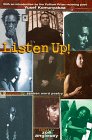
Listen Up! Spoken Word Poetry edited by zoe anglesey

Listen Up!What it is: A collection of poems by nine masters of the spoken word form who perfected their art in the Brooklyn Moon Cafe and the Nuyorican Poets Cafe here in NYC. A short bio of each of these poets of color is followed by three or four samples of their work. Spoken word poetry kinda defies definition, but it’s a little like a story, a little like a song, and usually has a beat. It can be confrontational, contemplative, both, or neither.

What it ain’t: the Beat poets of the 60’s! There’s still some finger snapping involved, but this modern spoken word is an organic kind of poetry that is still growing and evolving as an art form.

Who will like it: Anyone and everyone who digs the stylins’ and profilins’ of the spoken word form.

A Sample: Excerpt from Jessica Care Moore’s “Black Statue of Liberty”: I stand still above an island, fist straight in the air/Scar on my face, thick braids in my hair/Battle boots tied, red blood in the tears I’ve cried./Tourists fly from all over just to swim near my tide/Or climb up my long flight of stairs./But they trip on their shoe string lies./Piece by piece they shipped my body to this country/Now that I’m here, your people don’t want me./I’m a symbol of freedom, but I’m still not free/I suffer from class, race and gender inequality./

Movin’: Teen Poets Take Voice edited by Dave Johnson

MovinWhat it is: The cream of the crop of teen-penned poems collected from the terrific New York Public Library and Poets House teen program, Poetry in the Branches. Editor Dave Johnson led poetry workshops where teens could write/read/share their poetic endeavors. Johnson picked these 36 pieces to represent all the good stuff he heard.

What it ain’t: Cheesy! This is sincere, from the heart poetry.

Who will like it: Wanna-be published, currently adolescent poets.

A Sample: Shoes/They’re my old men in rocking chairs,/spitting biographies into the sky./They’re gatherers of stories,/picking up the spit of kings,/the seats of beggars,/and the smell of babies/from crannies in the sidewalks/that glitter like a prostitute’s makeup/when the sun hits right./And the tales of the world,/in elegant calligraphy,/are written on their soles./–Ben Zeitlin

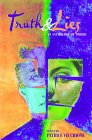
Truth & Lies: An Anthology of Poems edited by Patrice Vecchione

Truth & LiesWhat it is: A collection of poems by many different people (some you may recognize as a famous writer or philosopher) that illustrate the difference (and occasional similarities) between truth and untruth. Editor Patrice Vecchione writes in her introduction, “Poetry is a particular way of telling the truth…Often a poem will say what you know is true but had never heard put into words before.” It’s pretty deep and kind of interesting to read these poems and try and figure out why the editor chose them for this book, and how they all go together. Vecchione was also nice enough to include brief bios about the poets in the back of the book, so if you liked the voice of any particular person, you can dig in and find out where to find more of their works.

What it ain’t: No poetry in here by teens, folks. Just poems by professional and classical writers that adults thought you would like, and that may start your own writing wheels spinning.

Who will like it: Razor-red lipstick wearing Goth girls who sneak copies of Emily Dickinson into their black-light lit bedrooms, and boys who play in serious bands (and I don’t mean Making the Band, gelled-hair poptarts!) who are looking for inspiration for their deep-down, soul searching lyrics.

A Sample: An excerpt from Julia Alvarez’s “from 33”: Sometimes the words are so close I am/more who I am when I’m down on paper/than anywhere else as if my life were/practising for the real me I become/unbuttoned from the anecdotal and /unnecessary and undressed down/to the figure of the poem, line by line,/the real text a child could understand/

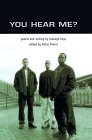
You Hear Me?: Poems and Writing by Teenage Boys edited by Betsy Franco

You Hear MeWhat it is: Uncensored, untouched, raw and real poetry by the usually silent half of the teenage population–guys. Editor and mom Betsy Franco decided early on that she wouldn’t try to push these poems into “themes” or “meanings,” but let them speak for themselves. And do they ever! There’s rash, brash, tender and moving poetry here from guys of all ages and from all over.

What it ain’t: Completely G-rated. You may stumble upon a few, umm, maturely themed poems. This may be great, or terrible, depending on your age and point of view!

Who will like it: Guys who swear they hate poetry and can’t understand it, and the girls who love them. <

A Sample: An untitled piece by Marcel Mendoza, age 16: Just because I love darkness/Doesn’t mean I’m depressed/Doesn’t mean I can’t love/Doesn’t mean I’m blind./Just because I love my Mom/Doesn’t mean I’m not a rebel/Doesn’t mean I can’t love others/Doesn’t mean I’m a mama’s boy./Just because I act psycho/Doesn’t mean I need medication/Doesn’t mean I can’t be compassionate/Doesn’t mean I don’t cry./

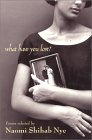
What Have You Lost? Poems selected by Naomi Shihab Nye, photographs by Michael Nye

What Have You LostWhat it is: A cool conceptual book of poetry that strives to answer the title question. Editor Naomi Shihab Nye chose poems about losing something, be it a real physical thing, or something ephemeral like freedom or innocence. But it’s not all sad and hopeless, some poems talk about the windows that open when the door of loss closes. Strategically placed black and white photos of people of different ages and races studying the camera with hard to read expressions add to the power of this interesting collection.

What it ain’t: Hard to understand. Anyone can relate to what it feels like to lose something. We all have lost something important to us, and it’s usually a moment we never forget.

Who will like it: Just about anyone, but especially crunchy granola girls, sensitive pony-tail guys, and aspiring photographers.

A Sample: Teenagers/One day they disappear/into their rooms./Doors and lips shut/and we become strangers in our own home./I pace the hall, hear whispers,/a code I knew but can’t remember,/mouthed by mouths I taught to speak./Years later the door opens./I see faces I once held,/open as sunflowers in my hands. I see/familiar skin now stretched on long bodies/that move past me/glowing almost like pearls./ –Pat Mora

SlowDance HeartBreak Blues by Arnold Adoff with artwork by William Cotton

slowdanceWhat it is: Only my most favorite book of poetry EVER! Arnold Adoff rocks–he’s written tons of poetry for children and teens, and it’s always great. But this is his best, IMHO. It’s like he crawled inside your teenage head and spread out it’s contents on a blank page. What kills me is how he KNOWS stuff, man! Stuff you were sure no adult understood, super serious feelings and situations that were SECRET, PRIVATE. Somehow, he gets it right and it’s like he’s in the teen tribe again, even though he’s a grown-up. And I hope I become just like him!

What it ain’t: stupid or condescending. It’s not some old writer trying to write about what he THINKS teens are like. It’s a sensitive writer who knows his audience and his limitations. It’s just perfect.

Who will like it: Secret journal scribblers and that quiet kid who sits in the back of the class and never talks.

A Sample: “Now”/This time/from trolls to tampax/says it all.

Sweep: Book of Shadows (Book 1) by Cate Tiernan

I’m not one to endorse series books–I’ve rarely read one that wasn’t the same old formula recycled over and over. But if this introductory book is any sign of things to come, then we’ve got a winner on our hands. Sweep is essentially about our main girl Morgan’s reluctance to accept the fact that she’s got some seriously witch-y genes, and I don’t mean Jordache. She’s starting to swoon during the full moon, and tell the future in small flashes. Then handsome, perky Cal Blaire comes to town and she falls under his spell pretty quick. Only Cal’s a practicing Wiccan and he wants Morgan and her posse to start a new coven w/ him. (The story’s only weak spot–like a guy new to town would draw possibly damning attention to himself by publicly announcing in his new school–“Hey, y’all, I’m a witch! Wanna be one, too?”) Morgan has to face her fate as a witch as the lines are drawn between her and her best friend Bree, who is also deeply in love with Cal. Who will win Cal and fly off into the moon rise on his-and-her broom sets? Until you’re able to score the next volume in this spooky series, sweep this off the shelf and under the covers for some midnight reading!

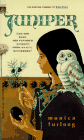
Juniper and Wise Child by Monica Furlong

These companion historical fictions are set in the medieval days of village healers and midwives who were often called witches because they employed herbal healing arts and worshipped pagan deities instead of the Christian god. The story begins in Juniper with Ninnoc, a spoiled castle princess-brat, who is used to luxury and always getting her own way. Her royal parents have another plan for her, and apprentice her to Euny, a strange old woman who lives alone in the woods. Euny teaches Ninnoc the ways of herbs and magic, and though her teacher is often harsh, Ninnoc ends up becoming a knowledgeable young doran, or witch, and taking the name Juniper. Juniper ends up using her new powers for good and saving her parents from losing their kingdom and castle to her father’s sister, an evil worker of magic. Wise Child continues Juniper’s story, only it is told in the voice of Wise Child, a village orphan who is adopted by the grown Juniper and trained in the art of natural healing. Wise Child’s knowledge and loyalty is tried when her real mother, a witch of the black arts, tries to lure her back and Juniper is accused by the village priest of witchcraft. Wonderfully crafted novels with tons of historical detail and Celtic folklore woven throughout, Juniper and Wise Child are gentle Wiccan fantasy fictions.

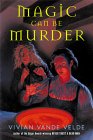
Magic Can be Murder by Vivian Vande Velde

Magic Can be MurderNola’s problem is that she’s only a little bit magical. In fact, she can really only do one spell well. By plucking a person’s hair and suspending it in a bucket of water, she can see everything that person is doing. But that little trick doesn’t keep food in Nola and her mother’s bellies, or find them steady work. Because that’s Nola’s other problem–her mother’s a little bit crazy. Most of the time she’s okay, but at the most inconvenient times she starts talking back to the voices she hears in her head. That type of behavior keeps Nola and her mother traveling from village to village trying to avoid accusations of witchcraft. At one of their stops, Nola accidentally leaves one of her spells going–and starts worrying that someone will find the bucket of fortune telling. But when she goes back to set things right, she finds that a murder has been committed in her absence and she is right in the middle of a medieval murder investigation! Lots of twists and turns in this witchy mystery make it wickedly fun reading.

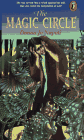
The Magic Circle by Donna Jo Napoli

The Magic CirclePoor Ugly One. Besides her unfortunate name, she just can’t seem to catch a break. Once she was a talented midwife and healer who kept evil spirits at bay with her magic circle while she welcomed new little ones into the world. Now she is a hunch-backed crone, tricked by the demons she once she commanded because of her immense personal pride. She must always flee their taunting cries as they attempt to get her to commit the final act of damnation–devouring a human child. So she lives alone in her house of bread and sweets, hoping to overcome her unthinkable destiny. Then a lost pair of children come begging to her doorstep…By the time you’ve figured out that this miserable figure is the witch from Hansel and Gretel, you can’t help but hope that the story will end differently. A psychologically fractured fairy tale from the master of re-mastered folklore, Donna Jo Napoli. You’ll never look at the villain in any story the same way again.

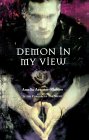
Demon in My View by Amelia Atwater-Rhodes


Demon in My View
Teen horror author Jessica Allodola is shocked when she comes to school one day and discovers that the brooding new guy is none other than the vampire Aubrey, a being who, according to all rules of physics and logic, cannot possibly exist outside of Jessica’s imagination. But there he is, in all his dark glory, the starring character from her latest novel, scarily real. Both repelled and attracted by Aubrey’s unique mix of evil and extreme hottie-ness, Jessica doesn’t know what to do or who would ever believe her outrageous tale. Enter teen-witch-in-training, Caryn Smoke. Caryn is a good witch, and determined to do anything she can to save Jessica from receiving Aubrey’s Hickey of the Undead. But does Jessica even want to be rescued? And are Caryn’s immature powers any match for Aubrey’s supernatural strength? Caryn may be in over her head with these two. Melodramatic and more than just a little campy, Demon is nevertheless a quick, angsty read for witches and bloodsucker-lovers alike.

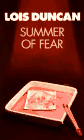
Summer of Fear by Lois Duncan

Rachel has the perfect life–a great family, a cute and attentive boyfriend, a best friend who’s like a sister to her, and the real love of her life—her dog Trickle. Then Rachel’s cousin Julia moves in. Rachel is prepared to do anything for Julia–after all, Julia’s parents, Rachel’s aunt and uncle, just died in a horrible car accident and Rachel wants Julia to try and feel at home despite her enormous loss. What Rachel wasn’t expecting is how “at home” Julia becomes–to the point of stealing her best friend and cozying up to her boyfriend. Trickle is the only other family member that dislikes Julia as much as Rachel–as Julia soon takes care of that as well! Rachel is afraid that Julia won’t stop until she has stolen Rachel’s entire life! But that doesn’t make Julia a witch…does it? If all you know of Lois Duncan is her book I Know What You Did Last Summer, then you don’t know her at all. Her teen thrillers are supreme–don’t miss out on this one or any of her other titles.

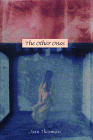
The Other Ones by Jean Thesman

The Other OnesIn school, I hated being called “gifted.” It either meant one of two things: you were smart, and therefore made fun of, or you were slow, and therefore made fun of. Either way, you were screwed. As to which category I fell under, I’ll let you be the judge. Bridget is gifted too, but in ways that make people pretty uneasy. In past times, they’ve burned those who’ve had Bridget’s “gifts.” Yep, Bridget is a witch, but one in complete denial. She doesn’t want to be a Wiccan, doesn’t want to be different or gifted. But when a mysterious new girl joins Bridget’s class giving off some desperately sad vibes, Bridget knows she has to use her powers to help. Jean Thesman is the best author for folks like me who only like a tiny bit of supernatural in their stories. Her stuff is super realistic with only the very tips of a broomstick poking through. I just love her writing and I think you will too, gifted or not!

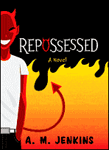
Repossessed by A.M. Jenkins

RepossessedWhen minor demon Kiriel “borrows” the body of Shaun, a teenage boy who is supposed to die when he accidentally walks into the path of an oncoming truck, he becomes fascinated by all the mundane human acts we take for granted, like seeing, breathing, and eating. But Kiriel knows he has to cram in as many Earthly experiences as possible before the Creator calls him back to his demon-ly duties. So he revels in the taste of ketchup, enjoys kissing his first girl (although he would have liked to do more) and tries to plant a few seeds of caution among the high school bullies and power brokers, in hopes that he won’t have to make their acquaintances later…downstairs. A.M. Jenkins’ inspired portrayal of a sympathetic demon and his longing to stay human, so that he might actually be NOTICED by the all-powerful (an apparently, all-too-busy) Creator, is funny, thought provoking, and surprisingly deep. Not only will you come away with a new appreciation of ketchup, but also your radical, amazing adolescence, which only happens once and will be over and done before you know it…